Locking up critics and opponents in psychiatric facilities has long been a method utilized by oppressive governments across the former Soviet bloc. According to right defenders and doctors, that legacy of punitive psychiatry has found a modern resurgence in Belarus.
At least 22 people recognized as political prisoners by Belarusian human rights defenders are reportedly undergoing compulsory psychiatric treatment, a measure that can leave them confined indefinitely outside the country's conventional prison system.
Their alleged offenses include insulting government officials, aiding activities deemed extremist by authorities, removing state flags, and committing alleged terrorism-related offenses.
Unlike conventional prison sentences, compulsory psychiatric treatment has no predetermined end date.
Those subjected to it cannot benefit from amnesties or pardons as other prisoners may.
"These people are in such a 'gray zone.' I would even say a 'black zone,'" said Vasyl Zavadski, a former prison doctor who trained as a psychiatrist.
Human rights defenders say they know of no political prisoner who has been released from compulsory psychiatric treatment since 2020.
From Criminal Proceedings To Psychiatric Confinement
One of the most well-known cases is that of Maria Uspenskaya, the widow of Andrey Zeltsar, who was killed in a September 2021 shootout with KGB officers at his apartment in Minsk.
Uspenskaya was detained the same day and initially held at the Akrestsina detention center before being transferred to Valadarka Prison.

In December 2021, she spent three weeks at a psychiatric facility in Minsk's Navinki complex, purportedly for an examination. She was accused of complicity in the killing of KGB officer Dzmitry Fedasyuk, and ordered by a Minsk court to undergo compulsory treatment at a psychiatric hospital.
No end date was set, and according to the Viasna Human Rights Center she is being held at the Republican Scientific and Practical Center for Mental Health in Minsk. Her release depends on doctors deeming that treatment is no longer necessary, followed by a legal process.
Neli Alfyorava, an artist and writer from Polatsk, was ordered into compulsory treatment after a closed trial in 2024. She had worked as an election observer and posted videos on social media before being prosecuted for allegedly insulting a government official.
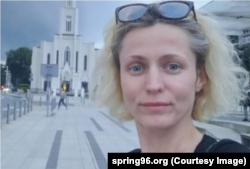
Natallya Manyla was ordered into treatment for allegedly assisting extremist activities, having helped political prisoners before her arrest.
Natallya Mikulich was sent to a psychiatric institution over accusations including insulting a government official, inciting social hostility, and libel.
Asker Alakhverdziyev, 25, was ordered into treatment with enhanced supervision in 2024 over allegations of preparing to participate in military activities.

Ivan Miksha, 21, was sent for compulsory treatment after removing Belarusian state flags from public buildings.
Danila Zharyn was ordered into treatment with enhanced supervision after being accused of a terrorist attack on an Interior Ministry institute in Mahilyou.
Who Decides On 'Treatment'?
In Belarus, a psychiatric examination can be requested by a police officer, investigator, prosecutor, or judge. The final decision to impose compulsory treatment rests with a court, said Svyatlana Halaunyova, a lawyer with the Viasna Human Rights Center.
She said people accused of insulting the country's strongman leader Aleksandr Lukashenko or other government officials are frequently sent for psychiatric examinations.

Belarusian psychiatrist Syarhey Papou, who previously practiced in Belarus and now works in Finland, said the distinction between medical and legal authority is important.
"Doctors only conduct the examination; they do not make decisions. The court decides what will happen to the person," Papou told RFE/RL.
Belarusian law requires people undergoing compulsory treatment to receive medical reviews at least every six months. If doctors conclude that a patient no longer needs treatment, they prepare their findings and submit them to a court.
But Papou said the process is far from clear, and security agencies can influence decisions even when doctors conclude that treatment is no longer necessary.
'Like Prison, Or Even Worse'
Palina Sharenda-Panasyuk, a former political prisoner, underwent several psychiatric examinations while serving her sentence in Belarusian prisons. She was not herself ordered into compulsory treatment but was sent for examinations at the Navinki psychiatric complex in Minsk.
She described a heavily secured facility surrounded by concrete walls and barbed wire, where prisoners were transported from detention centers in handcuffs.
"The conditions are like in prison, or perhaps even worse," she told RFE/RL.

She recalled being given oversized clothing and being required to walk with her hands behind her back. In the examination building, rooms had four iron beds, with furniture fixed to the floor. Toilets were accessible only four times a day and showers once a week.
"I categorically refused to talk to the psychiatrists. I told them it was punitive psychiatry," Sharenda-Panasyuk said.
Zavadski said the initiative to send political prisoners for compulsory psychiatric treatment comes from law enforcement agencies rather than medical professionals.
"This is not a medical initiative to send them for treatment but an initiative of people in uniform: police officers, investigators, prosecutors, KGB officers," he told RFE/RL.

People ordered into compulsory psychiatric treatment are not eligible for the same release mechanisms as conventional prisoners, Zavadski said.
"Ordinary prisoners are released sooner or later, after serving their sentences, through amnesty or pardon," he said. "But how can you release someone from treatment? There is no way."