



WASHINGTON -- As NATO leaders prepare to gather for next week's summit, a group of senior European conservative lawmakers visited Washington with a message they hope will resonate inside the Trump administration: Support for Ukraine and concern over Iran are not mutually exclusive.
The intervention comes at a delicate moment for the transatlantic alliance.
Following recent US military strikes on Iran's nuclear facilities, President Donald Trump's frustration with several European allies over their reluctance to support aspects of the US operation has added a new source of tension to an alliance already grappling with Russia's war against Ukraine.
That frustration was articulated publicly by Secretary of State Marco Rubio, who argued last week in Bahrain that Iran poses "an even graver threat to Europe" than to the US, and he criticized allies that "gave us a hard time" over US requests to use military bases during the operation.
Rubio warned such disagreements could cast "a real cloud over the NATO alliance."

"I hope [it] can be fixed. We'll see," Rubio said when pressed by RFE/RL on June 25.
Against that backdrop, members of the European Conservatives and Reformists (ECR) Group argue that the common perception that Europe prioritizes Ukraine while the US focuses on Iran is misleading.
"Ukraine is very important for us, and Iran is as well," Assita Kanko, deputy chair of the ECR Group, told RFE/RL on July 2 after meetings across Washington.
Her remarks reflected what several delegation members described as the central purpose of their visit: preventing disagreements over regional priorities from undermining broader transatlantic unity.
Rejecting False Choice Between Ukraine And Iran
The European delegation -- which included Kanko, Patryk Jaki, Adam Bielan, Gheorghe Piperea, and Stephen Bartulica -- held meetings this week at the White House, the State Department, the Pentagon, and leading conservative think tanks.
Their conclusion: Washington and Europe's conservative camp share more common ground than many observers assume.
"We don't want to allow the transatlantic relationship to be destroyed, because we have lots of common interests," Jaki told reporters.
Those interests, delegation members argued, extend well beyond Ukraine.

Kanko pushed back directly against suggestions that Europe overlooks threats emanating from Iran.
"Iran is actually having proxies in Europe, attacking also in my country, in Belgium," she told RFE/RL, alleging that networks linked to the Muslim Brotherhood in Brussels receive financing through Iranian-linked groups.
“We cannot just say we're fighting one war and not the other. We need to be able to protect our people against terrorism, against radical Islam, and we need to protect them against Russian influence.”
She also stressed that the two conflicts are strategically interconnected.
"Iran played a significant role in Russian aggression on Ukraine," she said, pointing to Tehran's supply of Shahed drones to Russia.
Rather than competing priorities, the lawmakers argued, Ukraine and Iran represent different fronts of the same broader security challenge facing Western democracies.
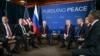
Bielan acknowledged that Europeans naturally place Ukraine higher on their list of priorities because of geography.
“For us Europeans, Ukraine is higher," he said. "But that's what allies do. They cooperate on many issues in different parts of the world.”
Seeking To Repair Strains Inside NATO
The delegation's visit also sought to reassure the Trump administration that many European conservatives support Washington's calls for greater defense spending and stronger burden-sharing.
Jaki said the administration's pressure on European allies had already produced results.
“The main aim of this conflict was to encourage EU partners to spend more money... and we have some kind of achievement," he said, while adding that future discussions could benefit from "softer words.”
The lawmakers repeatedly emphasized that Europe should strengthen -- not replace -- the US-led alliance.
Kanko argued that future European defense procurement should remain closely integrated with the US. "We are a team for tech, for defense, for security," she said.
Bielan also expressed optimism about closer bilateral defense ties, saying discussions on establishing a permanent US military base in Poland had been "very important" and that he was hopeful of positive developments in the near future.
On Ukraine itself, Bielan said US officials conveyed cautious optimism that a cease-fire could still be achievable in 2026.

"We heard...they are quite optimistic that we can achieve a cease-fire this year," he said, adding that the current administration continues to strongly support Ukraine and viewed President Donald Trump's recent meeting with Ukrainian President Volodymyr Zelenskyy positively.
Although security dominated discussions, ECR members also promoted a wider political agenda centered on strengthening the transatlantic partnership.
Jaki criticized what he described as Europe's pursuit of "strategic autonomy" if it meant reducing American influence, arguing instead for closer cooperation on trade, artificial intelligence, and economic competitiveness.
Despite these broader themes, the delegation consistently returned to one central argument: Disagreements over Iran should not eclipse the larger strategic convergence between Europe and the US.
Can NATO Bridge The Divide?
Whether that message succeeds may become one of the defining questions hanging over the NATO summit.
Kristen Taylor, associate director of the Atlantic Council's Transatlantic Security Initiative, said she believes the alliance faces a genuine political challenge.
"The summit threatens to be overshadowed by a Trump administration more frustrated by European reluctance to engage in US conflict in Iran than summit priorities, namely genuine progress by European allies on defense spending, defense production, and support to Ukraine," she told RFE/RL.
Taylor argued that NATO Secretary-General Mark Rutte faces the difficult task of balancing Europe's continued focus on Ukraine with Washington's emphasis on Iran.

"Bridging this gap will require the US to reaffirm genuine support for Ukraine and European allies to message greater support for US action in Iran," she said.
Analysts at the Center for Strategic and International Studies (CSIS) offered a similarly nuanced assessment during a press briefing previewing next week's NATO summit.
Max Bergmann, director of CSIS's Europe, Russia, and Eurasia Program and Stuart Center, said the current tensions over Iran represent a significant challenge for the alliance but pointed to historical parallels, comparing today's disagreements to the divisions over the 2003 Iraq War.
He argued that the Iran dispute has compounded broader strains stemming from the Trump administration's skepticism toward NATO.
Bergmann said many European governments found themselves politically exposed after being drawn indirectly into the Iran conflict without prior consultation from Washington, while public opinion in much of Europe opposed involvement.
He suggested European leaders were nevertheless likely to avoid airing those frustrations publicly at the NATO summit in an effort to preserve alliance unity.
Seth Jones, president of CSIS's Defense and Security Department and Harold Brown Chair, argued that despite the political tensions, the alliance's military foundations remain resilient.
He pointed to continued close cooperation among NATO militaries and intelligence services and said concerns over Russia's long-term military recovery mean US conventional and nuclear capabilities remain critical to European deterrence.
Jones also highlighted future US force posture in Europe and European decisions on next-generation defense procurement as issues to watch.
That underlying reality helps explain why European conservatives arriving in Washington sought to frame the Iran debate not as a source of division but as part of a broader shared security agenda alongside Ukraine.
Their message ahead of the NATO summit is a simple one: Europe has not abandoned Ukraine, but neither does it underestimate the threat posed by Iran.
If the alliance can acknowledge both priorities simultaneously, they argue, it may be able to move beyond one of the most politically divisive debates confronting transatlantic relations.

