


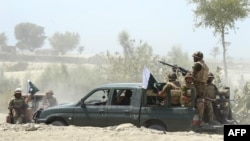
It was with a mixture of surprise and fear that Khan, a former Afghan soldier now living in Pakistan, received an offer to work with Pakistani security agencies on counter-militancy operations in Balochistan, the country's southwestern province bordering Afghanistan and Iran.
"The offer came from a former police officer in the previous Afghan government," Khan said, adding that the Afghan officer is well-housed in Pakistan and enjoys the support of local officials.
Khan said the man had already recruited hundreds of unemployed Afghan police personnel who crossed into Pakistan following the fall of Kabul in August 2021.
Khan, whose real name is being withheld for security reasons, told RFE/RL that the "facilitator" continued to contact him, either directly or through a third person, offering him work.
Khan repeatedly refused. Eventually, he said, the persistent approaches became so concerning that he moved to another location.
Pakistan's southwestern Balochistan Province is confronting a worsening security crisis. Baloch separatist groups, including the Balochistan Liberation Army (BLA), have waged a decades-long insurgency against the Pakistani state, seeking greater autonomy or independence for the resource-rich but impoverished province.
More recently, the Pakistani Taliban, or Tehrik-e Taliban Pakistan (TTP), has stepped up attacks in Balochistan's Pashtun-majority northern districts, widening a conflict that had previously been concentrated largely in neighboring Khyber Pakhtunkhwa and Pakistan's former tribal areas along the Afghan border.
If confirmed, the recruitment of Afghans would put some of the soldiers and police who fought the Taliban before the collapse of the Western-backed Kabul government in 2021 into Pakistan's increasingly complex fight against militants -- while potentially further complicating Islamabad's already tense relations with Afghanistan's Taliban rulers.
Pakistani authorities have not confirmed that such a recruitment program exists.
A source who tracks the activities of militants in the region through his contacts with them told RFE/RL that nearly 2,000 former Afghan police officers and soldiers have been recruited in Balochistan.
Khan, however, says his contacts indicate the number is much higher.
"I personally know several individuals who have joined these government-sponsored armed groups, which are headed by a former Afghan police officer," he said.
According to Khan, once recruited, the former Afghan security officers and soldiers are introduced to local police stations in their assigned areas so that they don't face problems when carrying arms or stopped for identification at police checkpoints. They receive roughly 40,000 Pakistani rupees a month ($145), he added.
Pakistan has intensified counterterrorism operations amid rising militant violence in Balochistan and neighboring Khyber Pakhtunkhwa.
The threats differ by region: Baloch separatist groups such as the BLA are concentrated mainly in Balochistan, while the TTP has traditionally been strongest in Khyber Pakhtunkhwa and the former tribal areas bordering Afghanistan but has increasingly carried out attacks in northern Balochistan. Islamic State-Khorasan (IS-K) also operates in the wider Afghanistan-Pakistan region.
State-Sponsored Militias
The formation of state-sponsored "lashkars," or units of armed volunteers, to fight the militants in their respective regions has also reemerged as a contentious issue.
Lashkars have a long history in Pakistan's Pashtun tribal areas, where local communities have mobilized armed groups in response to security threats before disbanding them once the relevant issue has been settled.
However, when the Pakistani military started supporting state-sponsored lashkars against the TTP in the tribal regions in 2007, it resulted in a bloody retaliation. Militants repeatedly targeted members of the militias, their leaders, and their communities, killing hundreds in subsequent years.
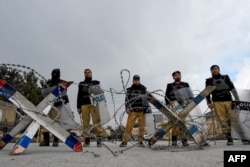
The idea has recently resurfaced as Pakistan confronts increasing militant violence in Balochistan and Khyber Pakhtunkhwa, drawing opposition from some politicians and civil society representatives.
Maulana Fazlur Rahman, leader of the conservative Jamiat Ulema-e-Islam (JUI) party, which has longstanding ties to the Afghan Taliban, rejected the government's call for civilians to raise "lashkars" to fight militants.
Speaking at a gathering in July, he said combating terrorism and militancy was the responsibility of state security agencies and warned that asking civilians to take up arms against militants would only deepen existing enmities.
Afghan Volunteers
Fazal Qadir Mandokhail, a regional parliamentarian and member of the JUI party, went a step further by telling the Balochistan provincial assembly in late August that thousands of former Afghan military personnel have been brought to Balochistan to fight militants.
He asked the civilian and military authorities to explain the purpose of bringing and housing former Afghan soldiers in the province.
Pakistani authorities have not commented on the matter, but when confronted by local journalists about Mandokhail's remarks, Balochistan Province's health minster, Bakht Muhammad Kakar, said anyone with proof of such practices must present it.
When RFE/RL approached Mandokhail for evidence to support his claim about the presence of "thousands of former Afghan Army soldiers in Balochistan," the lawmaker said Kakar knew the situation in the province very well but he could not depart from the government's official line.
Mandokhail declined to continue the telephone conversation and ended the call, saying he stood by what he had said in the Balochistan assembly.
The provincial government has said it has no verified information or evidence supporting claims that thousands of former Afghan soldiers have been brought to Balochistan.
RFE/RL sent several e-mails to Inter-Services Public Relations, the media wing of the Pakistani military, but did not get a reply. RFE/RL also called the office of Balochistan Chief Minister Sarfraz Bugti as well as the cell phone of his media spokesman, Shahid Rind, but did not receive a response.
'No Longer A Secret'
Abdul Qahar Wadan, provincial president of the nationalist Pakhtunkhwa Milli Awami Party (PkMAP) and a former member of parliament in Pakistan, told RFE/RL that they had noted the presence of former Afghan Army soldiers and policemen in parts of Balochistan and that it's "no longer a secret."
Wadan's PkMAP organized a three-day jirga, or assembly of elders, in Balochistan's capital, Quetta, from August 30 to September 1 to discuss the law-and-order situation and the presence of government-sponsored armed groups.
Wadan said the number of "arbakiyan" -- a term used in Afghanistan for local armed forces or militias -- was in the thousands and that they were well trained.
The source who tracks militants, said the matter is now becoming a cross-border issue between Pakistan and the Taliban in Afghanistan.
The source added a group of approximately 250 TTP fighters, including both Pakistani and Afghan Taliban, had recently established a presence in Balochistan. The TTP's insurgency has historically been centered in Khyber Pakhtunkhwa and Pakistan's former tribal areas, but the group has recently expanded its activities in Balochistan's Pashtun-majority districts.
That expansion has added another layer to Balochistan's security crisis.
While Baloch separatists are fighting for greater autonomy or independence, the TTP is an Islamist militant group seeking to overthrow the Pakistani government and impose its interpretation of Islamic rule.
At least nine Pakistani police officers were killed when militants stormed their security post in the Ziarat district of Balochistan in July. The attack was claimed by the TTP.
In a 2025 report, the Human Rights Commission of Pakistan (HRCP), an independent rights watchdog, says the "absence of a consolidated police presence" in several districts of Balochistan contributes to a "security vacuum" in the province. It said gaps in policing have led authorities to rely on paramilitary and military forces for some routine law enforcement duties.
According to Amir Rana, an Islamabad-based defense analyst, "political and civil actors in Balochistan have raised concerns over rumors regarding the recruitment of former Afghan security operatives" for the purpose of keeping law and order in Balochistan.
In a recent article on the subject, Rana wrote that "nothing could be worse" if reports that state agencies were using Afghan fighters in Balochistan proved to be true.
"It will only empower criminal elements and foreign agents," he said.

