


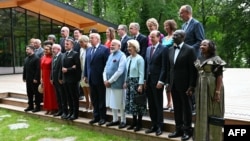
Leaders of the Group of Seven (G7) nations have pledged their "unwavering support" for Ukraine and agreed to increase pressure on Russia through sanctions and weapons supplies to Kyiv amid signs Washington is turning its focus back toward ending Europe's deadliest conflict since World War II.
The G7 said in a statement on June 17, the second day of a two-day summit in Evian-les-Bains, France, that with Ukraine's recent progress on the battlefield "there is now a new momentum" in the war, now in its fifth year.
"We commend Ukraine for its resilience and progress on the battlefield in recent months and emphasize there is now a new momentum," the statement said.
"To support and accelerate this new momentum, we agree to increase the delivery of air defense capacities, additional systems and interceptors, and long-range capabilities," it added.
Ahead of the summit, US officials reiterated that ending the war remains one of President Donald Trump's highest foreign policy priorities.
With a framework agreement reached with Tehran to extend a cease-fire and start talks on June 19 on a full peace accord, Trump, who met with Ukrainian leader Volodymyr Zelenskyy in France, said during the summit "I’m gonna do whatever I can" to help end the war.
European diplomats noted the tone of the summit had been constructive with regard to Ukraine, while Canadian Prime Minister Mark Carney told reporters on June 19 Trump appears to have pivoted in his view of the war in Ukraine, taking a more realistic position regarding the conflict.
"In the discussions about Ukraine, there has been a change in the outlook of the United States, a position that is...stronger against Russia and more realistic to the situation on the ground, in the war," Carney said.

Trump initiated a diplomatic push for a peace deal to end Russia's full-scale invasion of Ukraine shortly after taking office in January 2025. These efforts have stalled in recent months, particularly since the beginning of the war with Iran.
The G7 statement pledged to boost Ukraine's energy resilience in the face of numerous Russian air attacks on energy infrastructure that have sharply impaired the country's ability to provide heat and electricity at times, especially during bitterly cold winter months.
The statement also took direct aim at the Russian economy, pledging to increase pressure on it.
"In this context, we will strengthen our sanctions, including those on the oil and gas sectors. We consider this the right moment to proceed with additional measures, as President Trump has delivered a deal that we support in reopening the Strait of Hormuz," the statement said.

