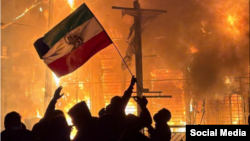
Sources familiar with a notorious trial that led to 10 death sentences for people who joined protests in the central Iranian city of Isfahan in January have revealed new details of torture, rape threats, and glaring judicial irregularities in the case.
Speaking to RFE/RL's Radio Farda, three sources with detailed knowledge of the closed-door trial said judges delivered the convictions without having been present to hear evidence from defense lawyers.
This included defendants giving shocking testimony of torture, including a man who accused an investigator of applying electric shocks to his genitals.
The identities of the sources cannot be revealed for security reasons.
'War Against God'
The case concerns the killing of Abbas Kamrani, a colonel in the Islamic Revolutionary Guards Corps (IRGC), and a homeless man during protests in Isfahan on January 8.


Defendants have been charged with moharebeh, or "waging war against God," aiding and abetting moharebeh, destruction of public property amounting to moharebeh, assembly and collusion, and propaganda against the Islamic republic.
The case was overseen by judges Morteza Barati and Mohammad Reza Tavakoli, who is notorious for harsh sentencing and caused a global uproar with a 2024 death sentence against a popular rap artist.
But the convictions were issued by Mahmud Kazemzadeh, a judge who was not present at the sessions, and an adviser named Mohammad Vakil.
Three legal experts, including lawyers and law lecturers, told RFE/RL that if the verdicts were not delivered by the presiding judges, it was a violation of Iranian law. Their identities could also not be revealed.
Beatings And Intimidation
A review of court documents obtained by Radio Farda shows that confessions attributed to the defendants against themselves and each other were among the evidence used to issue the convictions.
This was despite the defendants telling judges Barati and Tavakoli that they withdrew their confessions, which they said were extracted from them after beatings, the use of a taser, and threats of rape and sexual abuse.
RFE/RL has previously reported that families of many of the defendants said they were tortured in prison and forced to confess to charges they deny.

The new information from RFE/RL sources provides detail on how defendants were intimidated during the trial and prevented from presenting evidence.
"Whenever the youths stood up to speak in support of one another, the judge would intimidate and threaten them and not allow them to speak. He did not accept their testimony in each other's favor," one of the sources said.
This statement was confirmed by another of the sources.
They added that Barati repeatedly forbade defendants to use the word "torture" and had it struck out of the court transcript.
"If you say you were tortured, the IRGC will file a complaint against you," he reportedly told defendants.
Masked Men In Court
According to Radio Farda's sources, 12 men, all wearing face masks and hats, attended the court hearings.
"They were the interrogators of these young people, and the lawyers in the case repeatedly protested that they should not be present because they create fear. The young people say they were tortured by them and that they are afraid, but Barati and Tavakoli paid no attention to these protests," a source said.
Several defendants, including twin sisters Taraneh and Romina Rahimi, accused witnesses in court of physically assaulting them. Taraneh has been sentenced to death, while Romina has been given 25 years in prison, according to their family.
"This man gave electric shocks to my testicles and neck. I was waiting for the investigator to come and tell him that I was tortured, but the investigator himself beat me," another defendant, Mohammad Faridani, also known as Faridunizadeh, reportedly told the court.
"At least one of the defendants was sexually assaulted," a source told RFE/RL.
Another feature of the case was the use of cellphone video as evidence. A defense lawyer told the court that video allegedly taken from Taraneh Rahimi's phone had actually been ripped from social media. A prosecutor responded that the video was not important, but it was later cited in her conviction.
According to Radio Farda sources, a film was shown during the trial that the prosecution claimed showed Romina Rahimi handing over a bag containing a Molotov cocktail to another protester.
"They played the same video three times as evidence, but it did not show any such thing. In the end, they were unable to demonstrate anything," one source said.
This video was also cited in the eventual conviction.
Defense lawyers have lodged appeals against the sentences, but their chances of success are unclear.
The case comes amid an intensifying crackdown on dissent in the Islamic republic, where the authorities have jailed lawyers, activists, journalists, and intellectuals.
The growing clampdown coincided with the mass protests against Iran's clerical rulers in January and the ongoing conflict that began when US and Israeli forces attacked Iran in late February.