


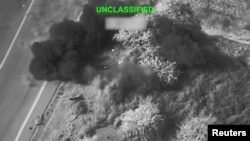
US forces stepped up attacks on Iranian sites, reportedly striking key bridges, railways, and an airport, prompting retaliatory action by Tehran, even while the White House said talks between the warring sides were still under way and that diplomacy remained a viable option.
At 9:30 p.m. in Iran, "US forces began conducting a new wave of strikes against Iran for the sixth consecutive night to further degrade Iranian military capabilities," US Central Command (CENTCOM) said in a statement on July 16.
Hours later, CENTCOM said that the mission had been "successfully" completed and that "dozens" of Iranian military sites had been struck
"US forces, including fighter jets, aerial drones, and warships, launched precision munitions that hit dozens of Iranian military targets such as coastal surveillance and air defense sites, military logistics infrastructure, and maritime capabilities," it said.
White House spokeswoman Karoline Leavitt said the "reason for the recent strikes over the course of the last several days is because Iran violated the memorandum of understanding that we struck with them."

"Specifically, in the memorandum of understanding that they signed, they were not to fire on commercial vessels moving through the Strait of Hormuz, and unfortunately they have made the tragic decision for them to do that."
Blasts Reported In Iran
Early on July 17, Iranian state media reported explosions and attacks at several sites, although the reports could not immediately be confirmed and CENTCOM did not specify its areas of operations.
Strikes around the Gulf island of Qeshm near the Strait of Hormuz, the focal point of the conflict in recent weeks, were reported by Iranian media.
Tasnim news agency also reported that US fighter jets had attack the airport in Iranshahr, a city of about 100,000 people some 300 kilometers from the Gulf of Oman in the south of Iran.
Separately, Fars news agency said that a bridge in Bandar Khamir had been targeted in a US attack. Bandar Khamir is on the Iranian mainland across from oft-struck Qeshm Island overlooking the Strait of Hormuz
Later, Iranian media reported that five bridges in the south were hit in the latest wave of US strikes, adding that seven people had been killed. The reports could not be verified.
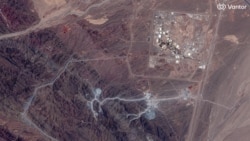
Explosions were reported in Bushehr -- the city is home to Iran's only civilian nuclear plant, a strike that state TV called a "continuation of the American enemy aggression."
Explosions were also reported at a railway junction in coastal Bandar Abbas and near Ahvaz, where residents told AFP that they had heard strong blasts for the second straight night.
Iran Retaliates
Early on July 17, authorities in Kuwait, Bahrain, and Qatar reported that its air defenses were responding to apparent Iranian missile and drone attacks.
Iranian media said the country's military was targeting US helicopters and planes housed at an air base in Bahrain "in response to the enemy's hostile action in targeting urban infrastructure and innocent people."
Iran's Islamic Revolutionary Guards Corps (IRGC) claimed in two separate statements on July 16 that it had struck US military bases in Kuwait and Jordan.
In one statement, the IRGC alleged that the US military had used its air bases in Jordan to launch attacks on Iran the previous night.

It said it responded with missile strikes on "the parking apron for US fighter aircraft and the new US command-and-control center in West Asia at Jordan's Azraq Air Base."
In a second statement, the IRGC claimed it had launched a combined missile and drone attack on "the satellite communications center, early-warning radar facility at Ali Al Salem Air Base, and the US military pier at Shuaybah, Kuwait."
CENTCOM has not yet responded to the IRGC's claims.
The renewed military action prompted increasing concerns among observers in the region and in the West that Washington and Tehran were on the edge of a return to a full-blown war.
A Viable Option
Still, the White House suggested that diplomacy remains a viable option.
"The president will hold them [Iranian leaders] accountable when they turn their back on the words that they state to the United States. But he is always open to diplomacy at the very same time," spokeswoman Leavitt told reporters.
"They have expressed they still want to make a deal to the president. We're talking to them, but again, the president is not going to allow them to fire on ships in the Strait without paying a consequence for that."
In a nationally televised address late on July 16, Trump said that "we're...winning big in Iran. You'll see the fruits of that labor very, very shortly," without elaborating.
Hopes the two sides may be moving toward a rapprochement were buoyed late on July 15 when Tehran allowed a US national who Washington says was "wrongfully detained" since 2024 to leave the country.

"The United States of America appreciates this gesture of Goodwill by Iran!" Trump said in a social media post.
Human rights attorney Jared Genser identified the American as Dena Karari, saying she was free after being brought up on "bogus charges."
Iran's judiciary said its investigation showed that no convicted American matching the person described by Trump, or any other American detainee, had been released from Iranian prisons or exchanged.
However, Karari's attorney said the 53-year-old woman had not been imprisoned but that her passport had been seized, preventing her from leaving Iran.
Tehran has often engaged in what has been called "hostage diplomacy" -- the seizing of dual nationals and foreign citizens for arbitrary reasons to be used to pressure foreign governments into meeting its demands.

