


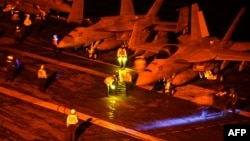
WASHINGTON -- US forces struck two Iranian rocket launchers on Larak Island in the Strait of Hormuz after the Islamic Revolutionary Guards Corps (IRGC) was observed preparing to launch rockets carrying sea mines into the vital waterway, a US official confirmed to RFE/RL.
The August 30 strikes mark the first publicly reported direct US attack on Iranian military positions in more than a month and come as Washington seeks to restore shipping through one of the world's most strategically important maritime chokepoints.
The US official said IRGC forces were preparing to launch the rockets with sea mines into the strait. Last week, US Central Command said American forces had completed clearing sea mines from the strait's international shipping routes and were keeping a close watch on activity there.
"US forces are monitoring the area closely and remain prepared to protect the free flow of commerce through this essential waterway," the official said.
US Central Command said that "US forces took limited, precise action against IRGC mine-laying forces posing an imminent threat in the Strait of Hormuz. In essence, Iran created the threat and the US military eliminated it to protect civilian mariners, commercial shipping, and the free flow of global commerce."
Iran's hard-line IRGC vowed retaliation. In a statement carried by Iranian state media, it acknowledged "the martyrdom and injury of several of our fighters and compatriots" and said the attack would "result in the punishment of the aggressor."
The IRGC later said it fired ballistic missiles at two bases housing US forces in Jordan in retaliation. Jordan, a close US ally, said it intercepted eight incoming missiles that entered its airspace early on August 31.


A Warning Over Hormuz
Experts interviewed by RFE/RL said the US strike is less significant as an isolated military action than as a demonstration that Washington is prepared to use force to prevent Iran from restoring its ability to threaten shipping through Hormuz.
Alex Plitsas, a nonresident senior fellow with the Atlantic Council and a former Pentagon official, said the latest exchange began after Iran struck a ship off the coast of Oman.
"Today's tit-for-tat strikes began after Iran struck a ship off the coast of Oman and then was attempting to launch a small number of mines into the strait," Plitsas told RFE/RL. "The US struck the launchers."
Plitsas said he believed Iran's attack on the ship was "in direct response to US statements about increased oil flows out of the Strait of Hormuz in recent weeks," intended to demonstrate that Tehran could still strike maritime targets and increase the risk level for shippers.
The distinction between a physically blocked waterway and a waterway made too dangerous for commercial traffic is crucial, he said.
"The strait itself is physically open," Plitsas said. "Reduced flow at this point is largely due to the risk of an Iranian attack on a ship."
That means clearing mines and destroying identified launch sites may not be enough to restore normal traffic. Iran can continue using missiles and drones to threaten vessels, and the US cannot eliminate every potential launch site or weapon.
"It'll be virtually impossible to strike every Iranian missile or drone, so the Iranians can continue to harass ships and keep the strait held at risk for some time," Plitsas said.
He said the current situation could persist in the absence of a return to large-scale combat, until pressure on Iran produces a negotiated settlement.
The result is a difficult test for Washington. The military objective is to protect the waterway, but commercial operators must also be convinced that the risk of sailing through Hormuz has fallen enough to justify resuming regular traffic.
Not A New Phase Of War
Jason Brodsky, policy director at United Against Nuclear Iran, said the strike was a signal that Washington would not allow Iran to reverse what he described as American gains in recent weeks in ensuring freedom of navigation in Hormuz.
"Today's strike is a signal from the US that it is not going to allow Iran to reverse the American gains in recent weeks over ensuring freedom of navigation in the Strait of Hormuz," Brodsky told RFE/RL.
But Brodsky cautioned against portraying the attack as the beginning of an entirely new phase of the conflict.
"It's not a decisive shift to a new phase of the war," he said. "Rather it is a reminder that the US has the will to police the Strait of Hormuz."

The more consequential development may be Iran's response. Speaking before the report of the IRGC's retaliatory strikes, Brodsky said Tehran is expected to lash out as it suffers economically, and that US policymakers understand the dynamic.
"How the US responds to any Iranian attacks will matter most," he said. "A decisive American response will be required to demonstrate that the US has the endurance to continue the blockade for as long as Iran refuses to submit to US demands."
That could create a cycle in which Iran seeks to impose costs on US forces or shipping without returning to full-scale war, while Washington responds whenever it determines that Iranian actions threaten navigation.
Hormuz Open, But Traffic Severely Constrained
Ian Ralby, head of the maritime-security firm Auxilium Worldwide, said the US strike underscores that the conflict between the US and Iran remains unresolved.
"Today's strike indicates what any serious observer has known all along, which is there remains an international armed conflict between the US and Iran," Ralby told RFE/RL. He said the attack showed there are "a number of unresolved issues that do not have any clear timeline for their resolution."
The continued weakness of shipping through Hormuz illustrates the problem. Ralby said traffic is among the lowest seen during the conflict, with about five vessels a day traveling in either direction and some days with no traffic at all.
For Ralby, that demonstrates that Washington remains "poised and ready and willing to use force against Iran -- both at sea and in its sovereign territory -- in order to accomplish its goals."
But military action alone cannot remove the risks facing commercial operators. Even an attack that does not close the waterway can deter ships, increase insurance costs and push companies toward alternative routes.
The next Iranian moves will therefore be critical. Tehran's pledge to punish the aggressor came as the IRGC reported casualties in the Larak Island attack, creating pressure on Iranian leaders to demonstrate that US attacks will carry a price.

Ralby cautioned that any escalation may not remain confined to Hormuz. He said the region has multiple potential flashpoints and warned that frustration with the status quo could lead one of the parties to act in a way that triggers renewed violence.
"The situation in Hormuz is unlikely to be resolved anytime soon," Ralby said. "There are short tempers and short fuses among a number of the players."
Iran has often attacked US bases across the region, Ralby noted, while the involvement of the Houthis and piracy incidents create additional opportunities for violence. The next escalation could therefore spread "well beyond the geographic confines of the strait of Hormuz."
He also pointed to Lebanon and Gaza as flashpoints where continuing violence could prompt Iran or the Houthis to attack in new ways.
"So this thing could spiral further out of control than it has at any moment," Ralby said.
Global Economic Stakes Rise
The consequences of a prolonged disruption in Hormuz would extend well beyond the military confrontation. Ralby said the global economic picture is becoming increasingly concerning as the Northern Hemisphere approaches winter and heating-oil demand is expected to rise.
He warned that the problem could shift from higher energy prices to questions of physical supply and potential shortages, depending on the severity of the winter.
"We become closer and closer to the winter period for the northern hemisphere with a demand for heating oil will start to spike in the next two months," Ralby said, raising concerns about "not just price but supply and then overall shortage."
China could add another layer of uncertainty. Ralby said Beijing has been artificially decreasing its demand for oil, but a renewed increase in Chinese consumption could send oil prices higher and deepen the economic effects of the standoff.
He warned that such pressure could also encourage more states to conduct transactions with China outside the dollar-based financial mechanisms that have helped underpin US economic influence for decades.
A Fragile Status Quo
For now, the central question is whether the August 30 strike and the IRGC retaliation remain isolated exchanges or become the start of another cycle of escalation.

Washington has shown that its effort to protect navigation extends beyond clearing mines from shipping routes. It is also prepared to strike Iranian military assets when it believes they are being used to threaten the waterway.
Iran, meanwhile, retains the ability to keep commercial shipping at risk without necessarily attempting a conventional blockade. That leaves Hormuz in an unstable middle ground: physically open, but with traffic severely constrained by the threat of attack.
Plitsas said that status quo could persist for some time if neither side returns to large-scale combat. But Ralby's warning about regional flashpoints and the economic pressure building around Hormuz underscores how difficult it may be to contain the conflict indefinitely.
The immediate test will be how Washington responds to the latest Iranian retaliation in Jordan. The longer-term challenge is whether the US can make the waterway sufficiently secure for commercial operators without triggering a wider war.

