


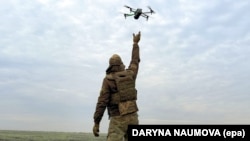
In an interview with RFE/RL's senior correspondent in Washington, D.C., Alex Raufoglu, Retired Rear Admiral Mark Montgomery warns that Russia, China, Iran, and North Korea are increasingly coordinating their military, technological, and economic resources to challenge the West on multiple fronts.
Montgomery served 32 years in the US Navy, retiring as a rear admiral in 2017. From January 2013 to October 2014, he led Carrier Strike Group 5 in the US 7th Fleet aboard the USS George Washington aircraft carrier.
Now the senior director of the Center on Cyber and Technology Innovation at the Foundation for Defense of Democracies (FDD), Montgomery recently returned from visits to Ukraine and the Middle East.
RFE/RL: How are Starshield restrictions affecting Ukrainian military operations, and what impact did you observe on the battlefield?
Mark Montgomery: I was there between the two shutdowns, but I had a pretty good understanding from the first one, talking to operators who experienced it and learning about the effects.
Starshield is really important to the Ukrainian war effort. It allows them to minimize casualties on the front line but also among the civilian population.
When Starshield goes away, for whatever reason, or when it is throttled down to a low speed limit, it effectively becomes unavailable for practical use. That has a significant negative impact on Ukrainian military and societal resilience.

RFE/RL: Russia is stepping up sabotage, GPS jamming, cyberattacks, and other hybrid operations in the region. Is Moscow exploiting uncertainty over Western support for Kyiv to open a broader front against NATO?
Montgomery: I think these are two separate things, but their timing is not just a coincidence. [Russian President] Vladimir Putin realizes that the US is attempting to pressure Ukraine into agreeing to territorial concessions to achieve a cessation of hostilities. It is clear that these Starshield throttlings are being done intentionally. I think they are being carried out at the behest of the US government as a way to pressure President [Volodymyr] Zelenskyy.
At the same time, Putin sees this and realizes he needs to put pressure on Europe, so that Europe also does not encourage or support Ukraine in defending its territorial integrity. This Russian new-generation warfare, which is what their hybrid warfare is called, mixes cyberattacks, information warfare, disinformation, economic attacks, drone attacks, and even physical attacks -- explosions and arson at factories, for example, in Estonia and Poland. This is all part of a Russian plan to communicate to Eastern Europe that NATO is not a credible response; it will not be there for its Eastern European allies and, therefore, fighting in Ukraine is a mistake.
RFE/RL: Is Kyiv effectively fighting Russia and its allies while the West struggles to keep pace?
Montgomery: Absolutely. Kyiv is fighting four countries. I'm a co-author, along with Brad Bowman and Elaine Dezenski, two other FDD scholars, of a book called Axis Of Aggressors. We document that these four countries -- Russia, China, North Korea, and Iran -- have transactional relationships with one another and have conducted at least 700 different instances of military, economic, or technological cooperation. The most profound of these is the support each country has given Russia in its fight against Ukraine.
Quite famously, Iran gave Russia thousands of Shahed drones at the beginning of the war, along with the blueprints to build more at plants in Russia throughout the war. That has now evolved into the Geran-2, Geran-4, and Geran-5 drones that Russia is using with some success against Ukraine.
North Korea provided 12,000 troops during the Kursk offensive. Since then, it has provided other troops for engineering work and other tasks, as well as 6 million rounds of artillery and mortar ammunition. The world's second-largest owner of artillery and mortar rounds has given the world's largest owner of artillery and mortar rounds decades' worth of supply.
Finally, China economically backstops the whole war. It has helped keep Russia's wartime economy afloat, but more than that, it has provided microelectronics that allow Russia to build cruise and ballistic missiles that hammer Ukrainian cities at night.
So most definitely, Ukraine is fighting the Axis of Aggressors -- all four countries. Russia may be the one losing troops on the front lines, but everybody else is contributing.
Iran's Allies And The Expanding Middle East Conflict
RFE/RL: Turning to the Middle East, is the US confronting Iran alone, or the same network of adversaries supporting Russia in Ukraine?
Montgomery: In the Middle East, I think the US, its Arab partners, and Israel are fighting Iran, Russia, China, and, to a lesser degree, North Korea.
Over the years, Russia and China have provided weapons and weapons-technology support to Iran. All three countries have provided different levels of nuclear support as Iran attempts to develop a nuclear weapon, whether through academia and research or through actual materials and technical support.
Most recently, during the conflict, it is alleged -- and I think reasonably assuredly -- that both China and Russia provided intelligence support to the Iranians to improve the accuracy of their attacks against US bases and Arab infrastructure using drones and ballistic missiles. By any measure, the US is fighting all of those countries.
RFE/RL: How effective has Washington's strategy been in weakening Iranian regime?
Montgomery: There is resilience within the regime. I think it survived because the US campaign started with an incorrect strategic objective: attempting regime change without having an armed adversary on the ground. You can't achieve regime change through air power alone. You need armed activists on the ground, as we experienced in Kosovo or Libya in 1999 or 2011.
Now I think the war has devolved into an economic strangulation campaign. And here I'll give the US administration credit. It has shown patience and discipline since the end of the memorandum of the cease-fire back in late June or early July, and has very consistently kept a maritime, naval blockade in place.

The administration has enhanced it, with the Treasury Department imposing sanctions on Iranian financial systems, and has not taken the bait when Iran shoots at ships. In other words, it doesn't immediately launch escalatory or even proportionate responses. It has made sure that Arab oil is flowing through a southern transit lane near Oman at a level that exceeds pre-February 28 levels, and that no Iranian oil is flowing.
Iran is a resilient state, but when you have no more fossil fuel sales, and those account for the majority of your incoming revenue, you will feel the pinch. Eventually, you will have to change the paradigm. That means either seeking an agreement with the US on US terms or lashing out against the US.
I assume that pretty soon [Iran's Islamic] Revolutionary Guards [Corps] is going to strike out, probably against our Arab partners, to try to get the US to change its behavior regarding the economic strangulation campaign.
RFE/RL: With Houthi activity in Yemen and attacks on Gulf infrastructure and US interests in Bahrain, are we seeing an Iranian effort to coordinate pressure across multiple fronts?
Montgomery: Iran is trying to make that happen and we probably should be helping the Saudis more.
The Iranian attacks on Bahrain are an attempt to get [the US] to respond. I think we've carried out attacks over the last few months, but they've generally been quiet, hitting things on Qeshm Island and other islands in the Strait [of Hormuz], as well as Bandar Abbas air facilities, where there are radars or other electronic sensing devices.
The aim is to reduce Iran's ability to target friendly tankers going through the southern transit lane closest to Oman. We've been very deliberate and patient, and we're slowly strangling the Iranian economy.
'We Ignored Ukraine's Lessons -- And Paid The Price'
RFE/RL: You mentioned some 700 instances of cooperation among Russia, China, Iran, and North Korea. Are they sharing tactics learned in Ukraine and now applying them in the Middle East?
Montgomery: You do see some of those tactics. First of all, there's no doubt that China and North Korea are present in Russia, particularly North Korea, learning from the combat there.
Iran has clearly learned the effectiveness of longer-range drones -- drones that go from 60 to 600 kilometers. The Shaheds have been used with some success.
Now, ironically, they're being used successfully at shorter ranges. They've been very effective against Bahrain, Kuwait, Qatar, and eastern Saudi Arabia because the West -- even though Ukraine was using ground-based drone interceptors for the last two and a half years and was showing them to the US -- failed to learn the lesson.
In fact, Zelenskyy offered them to the US in the summer of 2025. The US said it didn't need them and that it didn't need any help from Ukraine. We could have used that assistance. As a result, we were not ready for these kinds of short-range attacks. We're fine shooting down drones headed toward Jordan, Israel, or western Saudi Arabia because we can get aircraft in behind them and shoot them down.
But with these very short-range attacks from Iran into Bahrain, Qatar, Kuwait, the United Arab Emirates, and eastern Saudi Arabia, it's a very short flight. Your aircraft can't get into position. Therefore, you need these ground-based drone interceptors.
RFE/RL: Are you saying that Ukrainian counter-drone technology could have significantly reduced the damage to US and allied facilities -- and potentially shortened the campaign against Iran?
Montgomery: Absolutely. I'll go so far as to say that the reason we stopped the air campaign at 40 days was that we were not able to sufficiently knock down the drone threat to the Gulf -- Bahrain, Kuwait, Qatar, and eastern Saudi Arabia. Those drones were doing significant damage to US facilities and to our partners' infrastructure.
That absolutely would have been avoidable had the US Army learned from the Ukrainian Army over the last two and a half years.

But they chose not to. They ignored the opportunities. They ignored the lessons learned from the Ukrainian battlefield. As a result, what was otherwise an effective air and naval campaign -- I mean, it wasn't going to achieve regime change, but it was imposing significant costs on Iran -- had to stop because we could no longer provide that kind of air defense against drones.
RFE/RL: Stepping back, is Washington still preparing for yesterday's wars while its adversaries are learning from one another and coordinating across theaters?
Montgomery: The problem is that our adversaries are working together everywhere.
We can't ignore the Iranian nuclear problem. You can't ignore the Russian invasion of Ukraine and its new-generation-warfare attacks in Eastern Europe. You can't ignore China's pressure on Taiwan. They're all related.
I'll give you one last example. Because of their support for Russia, China and North Korea have received very high-quality support in return. Russia has allegedly given China submarine-quieting technology. That's one of our most important advantages, and it allows China to threaten our greatest asymmetric advantage: our undersea warfare capabilities.
China has also received airborne assault training from Russia, so it can better conduct an airborne assault alongside a cross-strait invasion.
Finally, North Korea has received what is described as space technology from Russia, but we all know it's really intercontinental ballistic missile technology that allows it to reach more of the US, more accurately.
This war between Russia and Ukraine has drawn the Axis of Aggressors closer together in a way we couldn't have imagined five years ago.

