


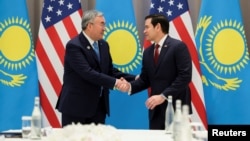
SAMARKAND, Uzbekistan -- US Secretary of State Marco Rubio said Washington would continue efforts to end Russia's war against Ukraine, warning that the conflict risks escalating beyond the two countries as he met with Central Asian officials in Uzbekistan.
Speaking to reporters in Samarkand on October 19, Rubio defended President Donald Trump's push for negotiations with Moscow and Kyiv, acknowledged limited progress, and said Washington remained open to any opportunity to secure a settlement.
“No one's winning that war,” Rubio said. “People are dying every day. Things are being blown up every day. Things are being destroyed every day.”
A Russian drone hit the crowded main park in the Kharkiv region town of Nova Vodolaha on October 19, killing three childen and three adults and injuring more than 10 others, Ukraine's Interior Ministry and the regional governor said. The ministry said one of the dead was an infant.
Rubio's visit, which brought nearly 300 American business representatives to Uzbekistan, also highlighted Washington's efforts to expand economic ties with Central Asia, a region where China has become the leading trading partner while Russia retains longstanding security and economic links.
Meeting with the foreign ministers of Kazakhstan, Kyrgyzstan, Tajikistan, Turkmenistan, and Uzbekistan under the C5+1 framework, Rubio said the US wanted to strengthen its presence without demanding that regional governments choose between competing powers.
Asked about reports that Russian President Vladimir Putin had proposed a meeting with Trump and Chinese President Xi Jinping to discuss ending the war, Rubio said discussions about a possible meeting had taken place but that he did not believe all arrangements had been finalized.
Trump remained committed to ending the conflict, Rubio said, adding that Washington would continue testing opportunities for negotiations despite the lack of progress so far.
“This is not a criminal case,” Rubio said when asked what evidence the administration had that Putin was serious about peace talks. “This is about diplomacy, and in diplomacy, you continue to try.”
He said a deal would ultimately depend on whether both sides were willing to make concessions.
Rubio: Dangers Beyond Ukraine
Rubio also defended the administration's decision to suspend certain sanctions for 60 days, saying it was intended to give ongoing talks with Russia and Ukraine a chance to produce results.
He cited the war's mounting human and economic costs, referring to Trump's repeated claim that as many as 25,000 people are dying each month in the fighting.
Rubio warned that the conflict posed dangers beyond Ukraine and Russia, particularly for Eastern Europe. Drones disrupted by electronic warfare, failed sabotage operations, and other incidents could cause damage in neighboring countries and risk triggering a wider confrontation, he said.
The US wanted to bring the war to an end because of both its devastating consequences and the risk of escalation, Rubio added.
Asked about Ukrainian President Volodymyr Zelenskyy's assertion that Washington had temporarily paused some intelligence sharing with Kyiv before resuming it, Rubio said there had been no interruption.
“I don't know where he's getting these things from or why he's saying these things to the press,” Rubio said.
He also declined to comment on reports that Ukraine had not received advance warning before Russian ballistic missiles struck Kyiv, saying he did not know the details of that incident. He acknowledged that US officials had examined a software problem involving Ukraine's early-warning system in an earlier episode.
Rubio said Washington had not changed its diplomatic presence in Kyiv, although the safety of US diplomats and facilities remained a concern.
Asked whether relations between the Trump and Zelenskyy administrations had fundamentally broken down, Rubio said Washington's priority was to end the war.
He acknowledged that Ukraine wanted to expand its use of the Starshield satellite communications system, which is controlled by the US Department of War, to conduct attacks beyond Ukrainian territory. He declined to discuss those negotiations further.
US Seeks To Compete With China
Rubio's visit also underscored Washington's ambition to gain a stronger economic foothold in Central Asia, where China is the principal trading partner of all five countries.
Chinese companies have secured deals involving regional energy resources and minerals, while Russia remains connected to the region through pipelines, security arrangements, and labor migration. Moscow's invasion of Ukraine has encouraged Central Asian governments to diversify their international relationships.
Asked how the US intended to compete with China, Rubio said Washington was seeking a fair opportunity for American businesses rather than asking regional governments to sever existing ties.
“This is not about coming here to say stop talking to somebody else or stop working with some other country,” he said.
Rubio said the US delegation had come to identify investment and trade opportunities, with agreements worth billions of dollars expected to be announced.
Uzbekistan, he added, wanted to maintain relationships with multiple powers. “They want to be friends to everybody,” Rubio said of the Uzbek government. “They want to have a relationship with everybody.”
He described Uzbekistan as a key regional player, citing its population, economic development, and tourism potential. Rubio said the country's reported annual economic growth of nearly 8 percent offered significant opportunities for further cooperation.
He also called for greater US engagement with Central Asia, saying the region had not received the attention it deserved from American policymakers over the past two decades.
The visit was intended to establish a foundation for longer-term cooperation, Rubio said, rather than simply produce a series of immediate commercial agreements.
Critical Minerals And Energy Security
Rubio also highlighted the importance of diversifying global supply chains, particularly for critical minerals used in advanced technologies and industries.
“It's just not smart for the whole world to depend on one place for 100 percent of anything,” he said, arguing that excessive dependence on a single supplier left countries vulnerable to political tensions and disruptions.
Countries with critical minerals and the ability to process them, he said, had an economic interest in developing those resources responsibly. Washington was interested in partnerships that could benefit local economies while diversifying supplies for American and global industries.

On energy, Rubio defended the administration's use of sanctions waivers affecting Russian oil supplies, rejecting the suggestion that the measures meant Washington had changed its position on purchases of Russian energy.
He said decisions had to take into account global prices, energy availability, and the economic circumstances of individual countries, including their ability to find alternative suppliers.
“It's not solely dominated by” the war in Ukraine, Rubio said of US foreign policy, adding that bilateral relationships and broader economic considerations also mattered.
He said Washington was close to a trade deal with India, another factor in the administration's calculations as it sought to balance energy policy and geopolitical priorities.
Rubio Backs Jackson-Vanik Repeal
Rubio also voiced support for repealing the Jackson-Vanik amendment, a Cold War-era US trade restriction that remains a longstanding issue in relations with some former Soviet republics.
Asked by RFE/RL why it had not been repealed, Rubio said the decision rested with Congress, although the administration supported removing the restrictions. “We are in favor of repealing it,” he said, adding that the administration had asked lawmakers to act.
Rubio said he had expressed support for repeal during his Senate confirmation hearings and noted that some members of Congress also favored the move. “Congress just hasn't gotten around to it, but we hope that they will,” he said.
Adopted in 1974, the amendment linked normal trade relations with certain nonmarket economies to emigration rights and other conditions. Originally aimed at Soviet restrictions on Jewish emigration, it has continued to affect US trade policy toward countries that emerged from the Soviet Union.
Repeal would remove a longstanding obstacle to closer economic relations and complement Washington's efforts to expand commercial ties with Central Asia.
Rubio's schedule in Samarkand included meetings with the five Central Asian foreign ministers, talks with Uzbek President Shavkat Mirziyoev, and engagements with American business representatives.
He also toured Registan Square, the historic Silk Road landmark that symbolizes Samarkand's centuries-old role as a crossroads of trade.
The visit preceded Rubio's planned trip to India, where US officials said negotiations on a bilateral trade deal were nearing completion.

