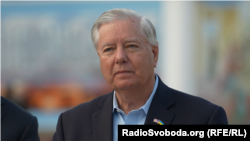
US Senator Lindsey Graham, one of the Republican Party's most influential voices on foreign policy and among Ukraine's strongest supporters in Washington, died on July 11 after what his office described as a "brief and sudden illness." He was 71.
During the final years of his career, Graham emerged as one of the strongest Republican advocates for military support to Ukraine following Russia's full-scale invasion, while also remaining among the Senate's staunchest supporters of Israel and one of Washington's most vocal proponents of a tougher policy toward Iran.
Staunch Kyiv Ally
During Russia's 2022 invasion of Ukraine, Graham emerged as one of Kyiv's closest allies in Washington, pressing successive US administrations to provide more military assistance, tighten sanctions on Moscow, and maintain pressure on Russian President Vladimir Putin.
His death came just hours after a visit to Kyiv, where he met Ukrainian President Volodymyr Zelenskyy and announced that bipartisan legislation imposing tougher sanctions on Russia had won the backing of the White House, potentially clearing the way for the measure to move forward.
The legislation, co-sponsored with Democratic Senator Richard Blumenthal, sought to expand economic pressure on Moscow by targeting countries that continued purchasing Russian oil and gas, a key source of revenue for the Kremlin's war effort.
Graham argued the bill would give Washington additional leverage to push Russia toward negotiations while increasing the cost of continuing the war.
“We’ve reached an agreement with the White House on a version of the Russian sanctions bill that they will support. It means it’s going to become law,” Graham told reporters in Kyiv on July 10.
Throughout the war, Graham was a frequent visitor to Ukraine. He repeatedly met Zelenskyy and senior Ukrainian officials, toured military and defense facilities, and argued that defending Ukraine was essential not only for European security but also for maintaining the credibility of the United States and its allies.
In a post on X, Ukraine parliament speaker Ruslan Stefanchuk said he was "deeply saddened by the news of Senator Lindsey Graham’s passing."
"Lindsey Graham was a steadfast friend of Ukraine who clearly understood that our struggle is a fight for freedom, democracy, and a just international order. His voice carried weight in the US Senate, and his support for our country was principled and resolute," Stefanchuk said.
His uncompromising stance toward the Kremlin made him a frequent target of Russian officials.
Moscow repeatedly denounced Graham's statements about the war, and Russian authorities opened criminal proceedings against him after comments he made during a visit to Ukraine in 2023.
Russian officials regularly portrayed him as one of the leading American proponents of a tougher policy toward Moscow.
Hard Line On Iran
For decades, Graham was among the Senate's strongest supporters of Israel and one of Congress's most outspoken advocates of confronting Iran.
A vocal opponent of the 2015 nuclear agreement between Iran and world powers, Graham supported President Donald Trump administration's "maximum pressure" campaign of economic sanctions on Tehran.

He repeatedly argued that Iran should never be allowed to acquire a nuclear weapon.
Graham also maintained that the United States should be prepared to use military force, if necessary, to prevent Iran from developing a nuclear weapon.
Foreign-Policy Hawk
Born on July 9, 1955, in Central, South Carolina, Graham graduated from the University of South Carolina's School of Law after serving in the US Air Force. He later continued his military career in the Air Force Reserve, eventually retiring with the rank of colonel.
After serving in the US House of Representatives from 1995 to 2003, he won election to the Senate, where he would serve for more than two decades.
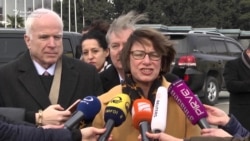
A close ally of the late Senator John McCain, Graham developed a reputation as one of the Republican Party's leading foreign-policy hawks.
He supported the wars in Afghanistan and Iraq, strongly backed NATO, advocated maintaining a robust US military presence overseas, and consistently argued that American leadership was essential to global security.
One of Graham's top staffers told NBC News that there had been no indication that the senator was feeling unwell immediately prior to his death. He was also scheduled to appear on NBC News's Meet The Press on July 12.