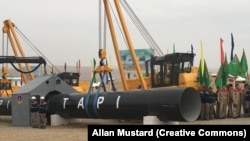

At an energy forum in Ashgabat in late October, Turkmenistan made an unexpected announcement. After years of delays and speculation that the project would be canceled, the forum audience was told the Turkmenistan-Afghanistan-Pakistan-India (TAPI) gas pipeline had just reached "the outskirts of Herat" and would be "commissioned by the end of 2026."
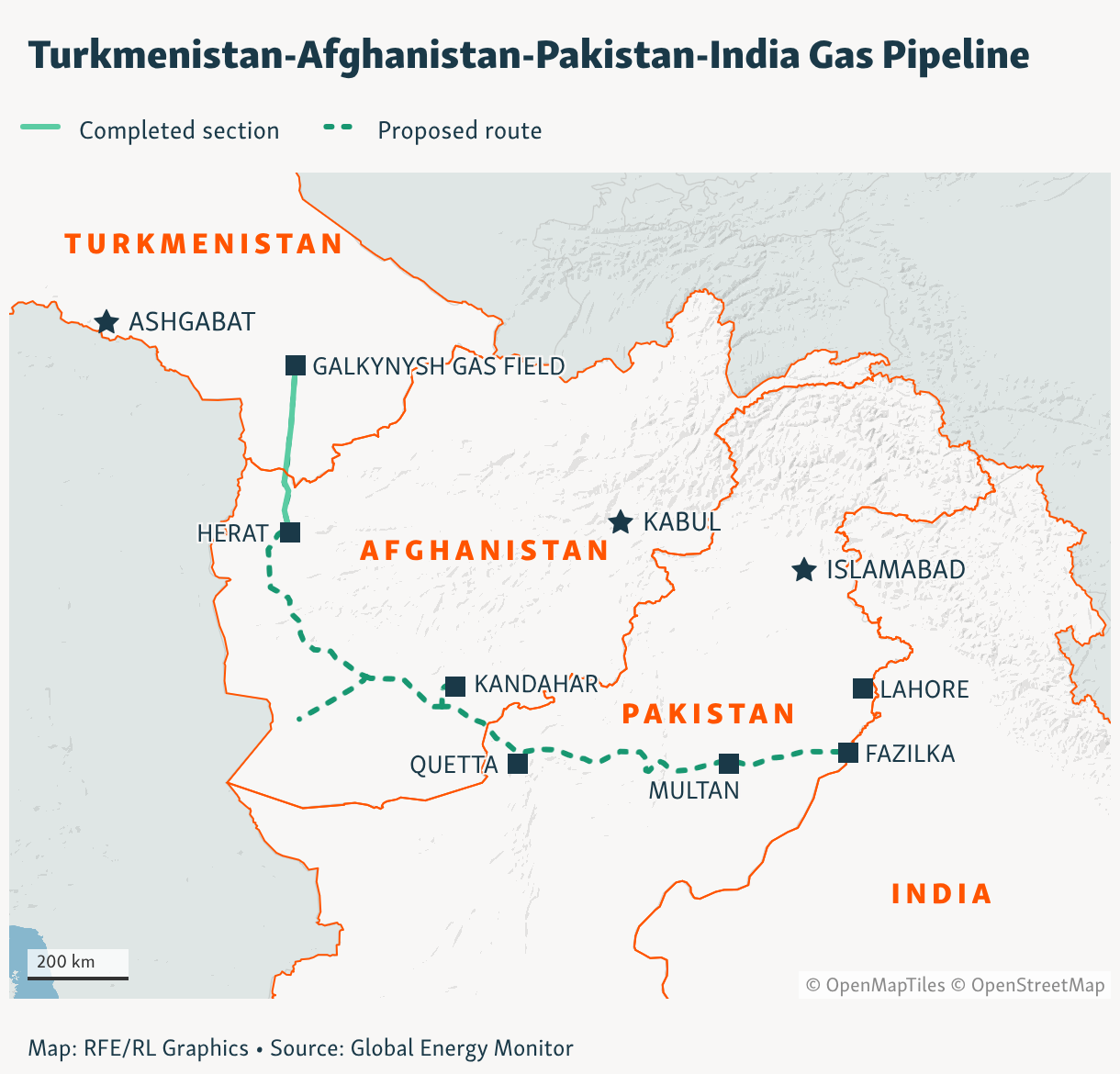
Depending on one's definition of "outskirts" for the northwestern Afghan city, that first claim appears to be true. Satellite images made on November 7 show the natural gas pipeline extending from Turkmenistan's southern border to a construction zone around 22 kilometers west of Herat's industrial district.

TAPI is a planned 1,800-kilometer gas pipeline to connect Turkmenistan's vast Galkynysh gas fields with consumers in Afghanistan, Pakistan, and eventually India.
The project was first envisioned in the 1990s, but local strife in Afghanistan and wider geopolitical tensions between the countries involved made the pipeline an increasingly tenuous prospect. India appeared to have turned its back on TAPI by 2024, and Pakistan's interest also waned around the same time. That cooling of interest, as well as the price tag -- projected at up to $10 billion -- and delays led some analysts to question Turkmenistan's unshakeable commitment to the project.
"The first thing is, it's a source of pride," John M. Roberts, a UK-based senior fellow with the Atlantic Council, told RFE/RL after news broke of the pipeline's approach toward Herat. "What I think has happened is that [Turkmenistan] got so fixated on the project that they had to do whatever they could to show it is still taking place."
But Ashgabat's dogged dedication to TAPI may have carried it to new relevance amid the energy crisis caused by the Iran war.
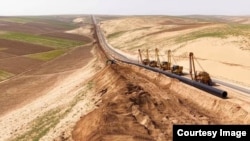
Tehran's closure of the Strait of Hormuz, which stifled energy supplies from the Persian Gulf, may have restored Pakistan's interest in TAPI. At the same Ashgabat energy conference where TAPI's progress was announced, Faryal Leghari, Pakistan's ambassador to Turkmenistan, vowed that Islamabad was now "committed" to advancing the pipeline.
"The fact that [Turkmenistan] have put their own money into developing the line to Herat may mean they will start looking at how to develop a partnership that could get the line further south to Kandahar and perhaps to Pakistan," Roberts said. The section of pipeline to Herat has cost Ashgabat a reported $600 million.
"The key question to my mind is whether they could manage to get Chinese support for such a project -- by which I really mean Chinese financial support -- given that this is probably too big a project for the Turkmens to handle on their own," he added. Afghanistan, for its part, has floated the idea of Russia investing in the pipeline's onward route.
As well as access to the gas TAPI will carry, Kabul would receive hundreds of millions of dollars in annual transit fees if the pipeline is extended into Pakistan and India.
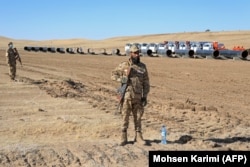
Afghans who have witnessed the construction work under way through Afghan territory told RFE/RL's Radio Azadi there have been multiple difficulties with the pipeline construction, including dealing with unexploded ordnance along its route. The insiders say work on the pipeline is carried out exclusively by Turkmen engineers and experts using Turkmen-owned equipment, with Afghan involvement limited to armed security personnel at the worksites.
"Every morning at the Torghundi border crossing between Afghanistan and Turkmenistan, large vehicles -- minibuses or buses belonging to the Turkmens -- would transport workers to the construction sites," one Afghan man, whose name was withheld for security reasons, told RFE/RL's Radio Azadi. "In the evening the workers would be transported back again."
In Herat, where spikes in gas prices and electricity shortages have hit residents and disrupted factories in recent months, locals expressed excitement at TAPI's approach, both for the flow of gas set to surge through the 1.42-meter-wide pipeline and the potential jobs created by its delivery infrastructure.
Herat local Abu Ali described the pipeline's approach toward the city as "a real sign of hope," telling RFE/RL's Radio Azadi "everyone feels happy about it."
Abdul Saboor Rahmani, a 27-year-old software engineer, was more measured. "Along with the rest of the people of Herat, I insist we be able to access this gas transparently and that only a small markup is made to the global market price rather than selling it to us at the current exorbitant rate or only slightly lower," he told RFE/RL's Radio Azadi.
Afghanistan has a tiny industrial base compared with its eastern neighbors and was only scheduled to receive some 5 percent of the pipeline's gas flow, with Pakistan and India splitting the remaining 95 percent equally. "This pipeline is large-scale in terms of potential physical capacity, but serving a local market" in Herat, Roberts pointed out.
Roberts says TAPI's eventual extension to the voracious energy markers of Pakistan and India should be a "no-brainer," but with geopolitical uncertainty in the region, coupled with Turkmenistan's reluctance to include outside investors to its infrastructure projects, the future of the pipeline remains uncertain.
"Nobody disputes Turkmenistan's gigantic resources, but harnessing them for export is a very different matter," Roberts added.
Sindre Langmoen contributed to this report.