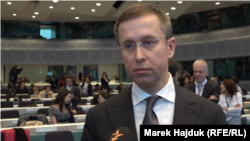
BRUSSELS -- Ukraine is doing everything it can to defend itself against a Russian onslaught aimed at "breaking the spirit" of its people as winter approaches and Moscow steps up its attacks on civilians and critical infrastructure, Prime Minister Serhiy Koretskiy told RFE/RL.
Koretskiy spoke in an interview on November 16, ahead of two meetings with European supporters of Kyiv this week and after a flurry of US-led diplomacy that produced no visible breakthroughs in efforts to end Russia's full-scale invasion of Ukraine, which will hit the five-year mark in February.
"Russia has significantly changed its strategy and is hitting bridges, hitting infrastructure, and hitting business a lot," Koretskiy said. "This is pure terror, aimed at breaking the spirit, breaking the resilience of Ukrainians, making life unbearable, impossible in Kyiv, the capital, and in cities with a population of millions."
With Russian attacks causing major power and heat outages, he said, "the main...focus is on how to anticipate and prevent the most negative consequences that can be."
"It's not winter yet.... But every day we are improving, working on [correcting] mistakes" when it comes to preparations for Russian attacks, he said.
The government is working on finding what President Volodymyr Zelenskyy has called a 70-billion-euro funding gap in 2027: 30 billion euros to cover the budget deficit and 40 billion "for extra-budgetary military needs," the prime minister said.
"I probably won't announce what we're going to get to soon. But, believe me, there is progress," Koretskiy said, adding that by late November or early December there should be "a clear plan on where and how we would be able to cover these needs."

A November 17 meeting in Brussels of the Ukraine Defense Contact Group, known as Ramstein, is to be followed by a meeting of the Coalition of the Willing in Berlin later in the week.
"There will be a Ramstein meeting, and it must deliver results," Zelenskyy said in his nightly video address on November 15. "This will send a strong signal, a signal to Russia that Ukraine will not be left without support."
The Ramstein effort coordinates military support for Ukraine among Western allies. The upcoming meeting will be led by the defense ministers of Germany and Britain.
Zelenskyy said Kyiv's priorities are to bolster the country's air defenses, including the acquisition of additional Patriot missile systems and National Advanced Surface-to-Air Missile Systems (NASAMS).
"The Russian ballistic missile threat remains very serious, and we have intelligence indicating that new strikes are being prepared," Zelenskyy said.
Ukraine has been struggling to defend its cities from an array of weapons including jet-propelled drones capable of flying nearly twice as fast as older models and has sought speedier delivery of more sophisticated Western defensive weapons.
Coalition Meeting 'Could Be Historic'
Zelenskyy said the Coalition of the Willing meeting is important and "could be historic."
German Chancellor Friedrich Merz, French President Emmanuel Macron, and British Prime Minister Andy Burnham will lead the latest gathering of informal grouping formed in early 2025 by countries pledging to aid Kyiv and potentially participate in a multinational peace force should a cease-fire be reached.
Merz said that more than 20 heads of state and government are expected. "Our goal is to achieve two things: first, to secure funding for Ukraine's defense for 2027 and, second, to reach a unified position regarding upcoming peace talks."
"We have a chance to establish a truly strong and united European position for the negotiations," Zelenskyy said of the meeting.
Merz and Zelenskyy were referring to US-led talks that are part of President Donald Trump's effort to end the war, a goal he made a priority when he took office for a second time in January 2025.
A round of US-Ukraine-Russia talks was held in Abu Dhabi on November 10-11, the first since February. The United States and Ukraine want Europe to be represented in future rounds, but a senior aide to Russian President Vladimir Putin suggested Moscow had not agreed to include European negotiators.
"What is currently being discussed is holding the next round in a trilateral format," Yury Ushakov said. "The date has not yet been agreed, and [as for]the expansion of the format...it has not been agreed with us."
"A great deal would have to be done before that could be agreed," Ushakov added when asked about the conditions for Europe participating. "In particular, it may be necessary to hold another round, or perhaps more than one round, of trilateral talks."
After the Abu Dhabi talks, US special envoys Steve Witkoff and Jared Kushner met with Putin in Moscow and with Zelenskyy, who was on a trip to Dublin, on November 12.
Kushner said he and Witkoff had spoken on November 16 with Ushakov and with "Ukraine and our European partners, including the National Security Advisors of Germany, France, the United Kingdom, Poland, and Italy, along with representatives of the EU and NATO."
In an X post, Kushner said they had "discussed how to facilitate direct engagement between Europe and Russia, which has been largely absent over the past four years," and also "began preparing the agenda for the next multilateral meeting, which we are working to convene in the near future."
"Important challenges remain, and a final agreement will require difficult decisions," Kushner wrote. "But we are making progress, in close coordination with Russia, Ukraine, and Europe, toward an outcome that can end this war, strengthen European security, and create the foundations for lasting peace."
In Abu Dhabi, the sides reached an agreement on a prisoner swap, which has not yet been publicly scheduled, but there was no visible progress toward ending the war and Russia sent clearly uncompromising signals on key issues.
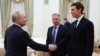
The talks were notable for the fact that the issues under discussion have been expanded to include overarching questions of European security architecture, in which Putin has been seeking a greater Russian role since he came to power over a quarter-century ago.
For Kyiv and its European supporters, that has added to the urgency of European participation in the process. Ukraine and the European Union have also voiced concern about an unprecedented summit on November 19 between Trump, Putin, and Chinese President Xi Jinping on the sidelines of an APEC meeting in China.
Ushakov announced a possible bilateral meeting between Trup and Putin; the White House has not confirmed that.
US officials had said Russia's war on Ukraine was not on the agenda of the Trump-Putin-Xi meeting, but Trump told reporters on November 16 that "my favorite subject, Ukraine" would be discussed.
Trump also said he thinks Putin "is backing down a little bit. I think he could be tougher. I think he could be a lot tougher, frankly. I think he's backing down. Frankly, I think he'd like to see it finished."

Russian attacks continued, however, and Ukraine's top diplomat in Washington, Denys Sienik, told RFE/RL on November 16 that restrictions affecting Ukraine's use of SpaceX's Starshield satellite communications system persisted for a seventh day.
The Pentagon, which is rexponsible for Starshield, said "there has been no change" to its "policy regarding support to Ukraine, including satellite communications."
Asked on November 16 about the reported Starshield restrictions in Ukraine, Trump said "I haven't heard that."
Restrictions of the speed at which Ukraine's military can use the system have hampered its ability to intercept Russian jet-powered attack drones near the front line and have given Moscow additional opportunities to strike Ukrainian targets.
A Russian strike on the city of Dnipro on November 16 killed at least one person and injured three others, while another attack hit a critical industrial facility in Ukraine's west-central Vinnytsya region, Ukrainian officials said.
In the southeastern Zaporizhzhya region, a Russian drone strike killed a 64-year-old woman and injured two others, while two people were killed in a Russian attack on Chernihiv in the north, officials said. They said Russian drone attacks also targeted energy facilities in the Cherkasy region of central Ukraine, leaving some consumers without electricity.
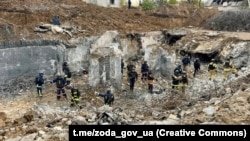
The head of the Zaporizhzhya region said that rescue operations have been concluded in the town of Komyshuvakha, where Russian forces struck a school that was being used as a humanitarian aid distribution center with multiple bombs on November 2, collapsing an underground space where people had taken shelter after an initial hit.
The death toll has reached 72, Mykhaylo Semikin said, and four people remained unaccounted for.
"In terms of the number of deaths, this is the most terrible blow to the Zaporizhzhya region and one of the most terrible in Ukraine," Semikin said in a Telegram post. "A tragedy that will forever remain a source of pain for our region and for the entire country."
Earlier on November 16, Russian occupation authorities in Crimea reported a strike on the Kerch Bridge, which links the Ukrainian peninsula with Russia, prompting traffic restrictions.
The Russian Defense Ministry said its forces had intercepted 1,336 Ukrainian drones over some 20 regions overnight -- a comparatively large number. Nearly 600 drones targeted the Moscow region overnight, with 191 intercepted near Moscow, Mayor Sergei Sobyanin claimed in a Telegram post on November 16.
A separate drone attack also reportedly sparked a fire near two oil depots in the southern Russian city of Azov in the Rostov region, according to monitoring Telegram channels.
Rostov region authorities said a local state of emergency had been declared in Azov following a drone strike. Fires broke out at four industrial facilities in the city, officials added, without providing further details.
Ukraine's General Staff confirmed the attack, saying its forces struck an oil depot near Rostov-on-Don, which it described as a key logistics hub for Russia's southern military grouping.
Speaking about Ukraine's long-range strikes targeting Russian energy facilities, Zelenskyy said Ukraine had disabled more than 55 percent of Russia's oil refining capacity.
"This is our justified response to Russia's refusal to de-escalate and its strikes on Ukraine's energy infrastructure," he added.
Zelenskyy said on X that Russian forces attacked at least nine regions on November 15, targeting energy, civilian, and railway infrastructure and injuring at least 16 people.