


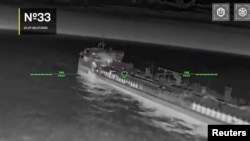
KYIV -- Ukraine launched multiple strikes against Kremlin energy assets, including oil terminals and tankers at sea, reportedly forcing Moscow to halt shipping through a major waterway as Kyiv intensifies what it has labeled its "long-range sanctions" against Russia.
Ukraine's General Staff on July 10 said 18 Russian vessels were hit in the Sea of Azov, including at least 10 tankers, three bulk carriers, and an auxiliary vessel, adding that damage assessments were ongoing.
It said the ships were used to provide Russia's military logistics and transport fuel, lubricants, military cargo, and other necessary items "to wage its war against Ukraine."

The strikes add to the dozens of Russian vessels hit this week as Kyiv looks to isolate the Crimean Peninsula, which Russia illegally occupied in 2014 and which has been struck by massive energy shortages since Ukraine launched its recent campaign.
Reuters quoted three industry sources as saying Russia had temporarily halted shipping through the Don-Azov Channel due to the Ukrainian attacks.
According to one of the sources, Russia's border guards notified shipping companies that all requests for passage through the Kerch Strait, which connects the Sea of Azov and the Black Sea, would not be accepted from 6:10 p.m. local time on July 10.
Russian Refineries Struck
In addition, Ukraine's General Staff said it struck the Ilsky refinery in the Krasnodar region, causing one of Russia's largest energy sites in the south of the country to catch fire.
"On the night of July 10, as part of the reduction of the military-economic potential of the Russian aggressor, units of the Defense Forces of Ukraine defeated a number of important military-economic and military targets of the enemy," it said on Telegram.
"Thus, the Ilsky oil refinery in the Krasnodar territory of the Russian Federation was once again damaged," it added.
It said the refinery is one of the largest in southern Russia and has capacity of up to 6.6 million tons of oil a year. "The plant produces gasoline, diesel fuel, and other petroleum products, which are used, in particular, to ensure the military logistics of the aggressor state," it added.
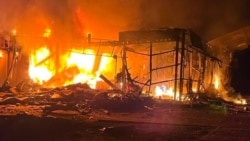

The General Staff said it also struck the Ust-Luga oil refining complex in the Leningrad region, a frequent target of Ukrainian drone strikes, and that it hit an oil depot in the Rostov region.
The results of the strikes could not immediately be independently verified.
Ukraine’s drone attacks on Russian energy sites have led to massive shortages throughout the country, with even Moscow -- which is often immune to crises in the country -- feeling the pressure, with long lines at gas stations leading to angry outbursts by drivers.
Reuters cited industry sources and its own calculation to report that domestic gasoline output fell to around 65 percent of normal levels as a result of the strikes.
Kostyantynivka Under Attack
Separately, regional Governor Vadym Filashkin reported that Russian forces had dropped seven aerial bombs on Ukraine's eastern besieged frontline town of Kostyantynivka on July 10, killing four people and injuring at least nine others.

“It was another deliberate blow to people, to civilian neighborhoods, to life that they are unable to create or understand,” he wrote on Telegram.
Russia and Ukraine have made conflicting battlefield claims regarding Kostyantynivka, with Moscow insisting it had captured the key eastern town of 2, 800 people while Kyiv has rejected the assertion.
US officials, including President Donald Trump, have attempted to revise peace negotiations between Kyiv and Moscow, but little or no progress has been reported, with both sides intensifying attacks in recent weeks.
Meanwhile, US lawmakers attempted to maintain economic pressure on the Kremlin.
Four senators said they had reached agreement with Trump to move ahead bipartisan legislation targeting countries buying Russian energy, potentially further slicing into the Kremlin's financial means to wage war.
Republicans Lindsey Graham and Roger Wicker and Democrats Richard Blumenthal and Jeanne Shaheen said they expect to roll out the updated legislation "very soon."
"As Russia intensifies its slaughter of civilians, it is imperative that the legislative and executive branches work together to create tools to exact a heavy price on those who buy Russian oil and natural gas, fueling [Russian President Vladimir Putin's] war machine," they said in a joint statement.

