


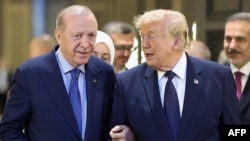
WASHINGTON -- US President Donald Trump has arrived in Ankara, where NATO leaders are gathering for what could become one of the alliance's most consequential summits in years -- not because it is expected to produce dramatic breakthroughs, but because it may define what NATO looks like after decades of overwhelming American military leadership.
The July 7-8 summit comes as Washington openly prepares European allies for a gradual shift in US military posture on the continent, presses members to dramatically increase defense spending, and signals that Europe's security must increasingly become Europe's responsibility.
Trump arrives carrying familiar complaints that many allies continue to benefit from American protection without contributing enough themselves.
But behind the public rhetoric lies a far more profound debate over NATO's future: how to rebalance the alliance without weakening its deterrence against Russia.

Senior US officials confirmed ahead of the summit that the Pentagon's ongoing force posture review in Europe could result in reductions of American forces stationed across the continent.
“There should be no surprise that we're doing a posture review," one senior official said. "That posture review very well may lead to us adjusting our posture because we're trying to shift burden to Europe.”
Another senior official told RFE/RL on July 6 that the review reflects "global demands" on US forces and insisted any troop adjustments would be driven by strategic rather than political considerations.
A Summit Measuring Europe's Readiness
For the Trump administration, Ankara is less about declarations than scorecards. The White House wants evidence that European allies are translating promises into military capability.
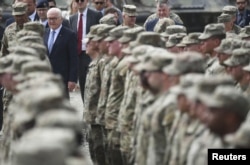
"We expect all allies to demonstrate meaningful upward trajectories, both quantitatively and qualitatively, in defense spending that results in fairer burden sharing," US Ambassador to NATO Matthew Whitaker told reporters ahead of the summit, highlighting Poland, Germany, and Nordic and Baltic countries as examples of allies moving in the right direction.
Trump himself has been considerably less diplomatic.
"I was disappointed with Italy. I was disappointed with the UK.... We were disappointed with Germany and France. Spain is a horror show. Spain is terrible.... They think they're in for a free ride," Trump said last week during an Oval Office meeting with NATO Secretary General Mark Rutte.
Although the US remains NATO's largest contributor in absolute spending, several allies -- including Poland, Lithuania, Latvia, Estonia, and Norway -- now devote a larger share of GDP to defense than Washington.
Following commitments made at last year's Hague summit, NATO members are expected in Ankara to present concrete road maps showing how they intend to reach defense spending equivalent to 5 percent of GDP by 2035.
Matthew Kroenig, a former Pentagon special adviser for defense strategy and policy, argues the summit will effectively become a "scorecard summit."
"The question is whether Europeans are really stepping up for the burden shift the Trump administration has in mind," Kroenig said on July 6 during a Brookings Institution discussion.
While acknowledging progress, Kroenig said US officials remain concerned that many allies still lack credible plans to reach agreed spending targets, while also questioning whether European industrial initiatives could duplicate capabilities already available from American manufacturers rather than strengthening NATO efficiently.
Toward 'NATO 3.0'
Beyond budgets, the summit reflects a much broader strategic transformation. Rather than dismantling NATO, many analysts said they believe Washington is attempting to redefine it.
Charles Kupchan, senior fellow at the Council on Foreign Relations, describes the process as a long-overdue rebalancing rather than an existential crisis.
"We are passing through a needed period of rebalancing with Europe doing more as the United States reallocates its assets and rejiggers its priorities," Kupchan said during a CFR briefing on July6.
While some analysts describe NATO as entering an era of strategic uncertainty, Kupchan argues the alliance's institutional foundations remain intact. "I don't think we're witnessing the end of the transatlantic alliance," he said. "The institution is intact."
Yet he also warned that Trump's approach has eroded one of NATO's most valuable strategic assets: trust.
"America's greatest strength is its partnerships," Kupchan said. "There will be more weapons and more tanks in Europe, but we're going to be in a heap of trouble if nobody likes us anymore."
Liana Fix, another senior fellow at the CFR, said she believes Europe now operates simultaneously in two strategic realities.
Publicly, leaders continue speaking about stronger burden sharing and a more capable NATO. Privately, however, governments are increasingly preparing contingency plans should Washington further reduce its military commitment.
"The Americans are withdrawing faster than the Europeans can fill," Fix said, warning that the alliance could face significant capability gaps, particularly in air defense, strategic logistics, and missile defense.
She argues Ukraine itself is becoming an increasingly central pillar of Europe's future security. "The more the US withdraws from Europe, the more Ukraine becomes a security guarantor to Europe," Fix said.
Ukraine Seeks Practical Gains, Not Symbolism
Ukraine arrives in Ankara facing intensifying Russian missile attacks and mounting shortages of advanced air defense interceptors.
President Volodymyr Zelenskyy is expected to meet Trump on the summit's sidelines while renewing appeals for additional Patriot missile systems following another deadly strike on Kyiv.
Tyson Barker, former US deputy special envoy for Ukraine's economic recovery, said he believes success for Kyiv will be measured not by political declarations but by tangible military commitments.
"Any commitment for more air defense would be a huge deal, and much needed," Barker told RFE/RL on July 6.
Rather than focusing on long-term NATO membership debates, Barker said the summit should prioritize immediate defense production, weapons deliveries, and industrial cooperation.
“I don't think the political messaging about NATO's future relationship with Kyiv can really produce anything good right now," he said. "The immediate needs are greater commitments of weapons, especially air defense, and enhanced cooperation on defense production.”
Barker also suggested Ankara could deepen an emerging "Black Sea dynamic" between Turkey and Ukraine through expanded defense-industrial cooperation.
Kroenig noted that despite criticism from Europe, the Trump administration is arguing that it continues to support Ukraine through intelligence sharing, expanded authorization for deep strikes inside Russia, and facilitating European purchases of American weapons.
However, he acknowledged Patriot interceptors remain among the world's most scarce military capabilities.
"I don't know if there's anything else the United States can or will do," Kroenig said. "It's one of those high-demand capabilities that remains in very low supply."
Middle East Expands NATO's Agenda
Although Ukraine dominates the security agenda, Ankara will also highlight NATO's expanding attention to the Middle East.
Senior administration officials told RFE/RL that Trump wants allies to assume greater responsibility for protecting commercial shipping through the Strait of Hormuz following recent regional instability.
Barker cautioned that European governments have already indicated a willingness to contribute to maritime security, but only once conditions stabilize and a durable cease-fire is established.
The summit's location also reinforces Turkey's growing geopolitical importance.

Trump is expected to hold bilateral meetings with Turkish President Recep Tayyip Erdogan, Zelenskyy and Syrian President Ahmed al-Sharaa, reflecting Washington's renewed diplomatic engagement across the region following months of heightened tensions.
Council on Foreign Relations experts argue that Turkey's role inside NATO is increasingly driven less by European security than by its strategic importance across Syria, the Eastern Mediterranean, and the broader Middle East.
Stephen Sestanovich, senior fellow for Russian and Eurasian Studies at the CFR, said the summit could also underscore Moscow's declining influence in the region.
“From Russia's point of view,” Sestanovich said, "what the summit represents is American outreach and a strengthening of relations with Turkey and Syria."
An Alliance Undergoing Transformation
Despite disagreements over strategy, most analysts agree Ankara is unlikely to produce either dramatic confrontation or sweeping breakthroughs.
Instead, it is expected to formalize a transition already underway.
Whether described as burden sharing, NATO 3.0, or strategic rebalancing, Washington appears determined to shift primary responsibility for Europe's conventional defense onto European capitals while preserving the alliance's core political and nuclear architecture.
The unanswered question is whether that transition can occur without creating dangerous security gaps -- and without weakening the confidence that has underpinned NATO for more than seven decades.
As leaders gather in Ankara, the challenge is no longer simply persuading Europe to spend more.
It is whether NATO can adapt to a changing distribution of power while preserving the unity that has long been its greatest strategic advantage.

